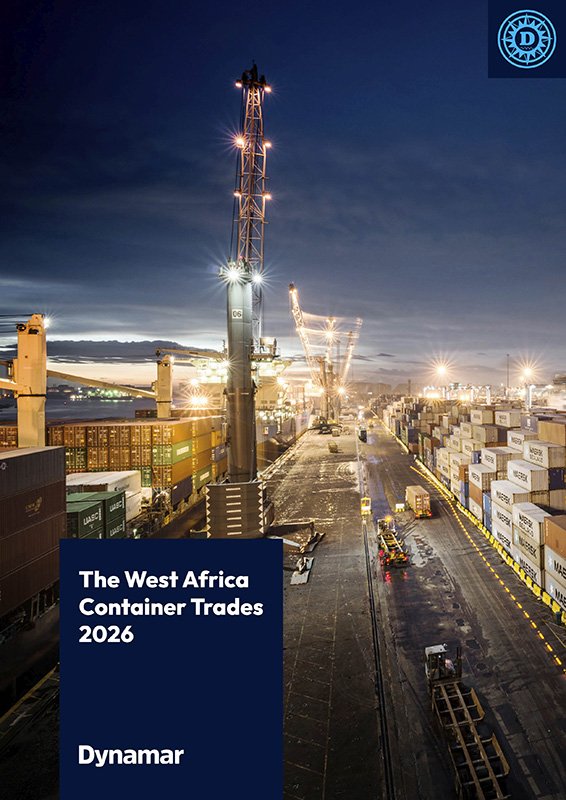
West Africa is an area of great potential. It is home to a wide range of natural resources, these powering its export trade, with containers particularly well suited to shipping many agricultural commodities. It is also a region that is developing and with a population growing quickly, these two characteristics mean there is an increasing demand for both capital and consumer goods, with manufactured items a mainstay of the dominant imports.
The West Africa container trade
The potential is beginning to be realised. Modern port facilities are now seeing the biggest ships afloat and, at the same time, anchoring local hub and spoke networks. Carriers are deploying increasing capacity throughout the whole system, and while these operators are led by the very biggest global brands, West Africa supports a range of specialists, with over twenty operators represented in total. They call around fifty terminals located in over forty ports with projects, expansions and improvements all in various stages of development.
The trade capacity model
Dynamar’s trade capacity modelling system provides a wide range of analyses. These take place for each West Africa specific trade, for each carrier present and for each country called. Throughout, the report looks at who calls where, with what capacities, and how these have evolved and is a good indicator of the trade leaders and followers; after all, capacity follows the cargoes!
Content:
Carrier Profiles: Detailed surveys and profiles of shipping lines offering services to, from, and within West Africa
Trade Analysis: In-depth look at each trade by service, carrier, and ports called, with detailed Annual Trade Capacity data
Port and Project Insights: Qualitative analysis of West Africa ports, their development projects, and the trades they connect
Supporting Data: Comprehensive data on containerised carryings, port throughputs, GDP, merchandise trade, and population statistics
Historical Context: Contextual country profiles providing background information on the region