
Besides our portfolio of quality standard studies, Dynamar also offers the weekly DynaLiners and monthly Dynamar Market Monitor
If standard is not enough for you, check out our tailor-made consultancy and marine investigation services
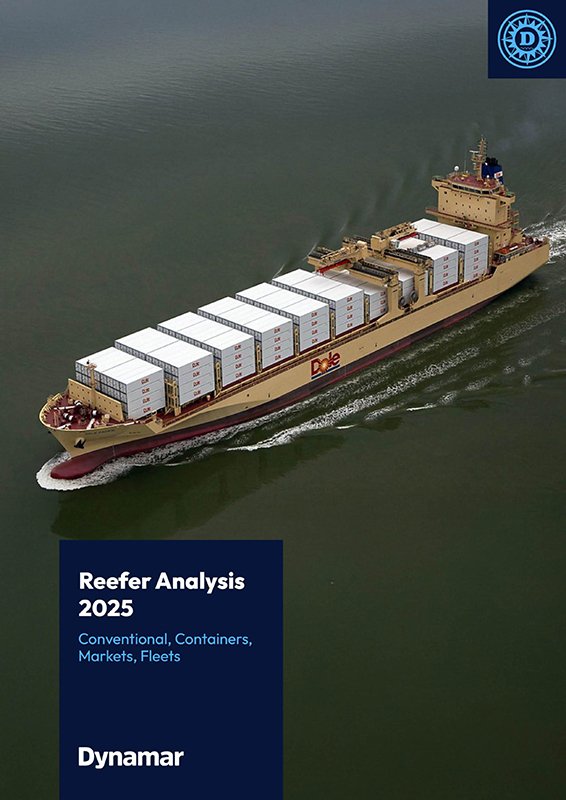
The reefer shipping industry continues to be shaped by the global geopolitical landscape, affecting trade routes, service patterns and demand for (container)ship capacity. As the driving force behind perishable goods transport, reefer shipping must navigate these challenging and embedded evolution of the overall shipping fleet.
In 2025, global trade faced heightened uncertainty following a major shift in United States policy after the inauguration of a new president. Free-trade principles gave way to higher import tariffs and broader protectionist measures with changing tariff adding further instability.
Alongside, the United States imposed exceptionally high port charges on China-linked vessels, disrupting container shipping networks. Chinese countermeasures increased uncertainty, although both sides later agreed to postpone these actions for one year. While not targeted at reefer shipping, the impact spread across the interconnected shipping industry. Futhermore, ongoing disruption in the Red Sea sustained diversions around the Cape of Good Hope.
These combined factors halted the earlier decline in freight rates and supported solid carrier returns. However, a broad return to the Suez Canal would likely reintroduce overcapacity, placing renewed downward pressure on freight rates.
Conventional reefer operators have been relatively insulated from recent trade and geopolitical disruptions. Few serve the United States extensively, and most operate vessels that are not affected by the discruptions. However, their pricing power remains indirectly influenced by fluctuations in container freight rates,
Despite this relative stability, conventional reefer shipping is increasingly becoming a niche segment. While fleet capacity remained broadly unchanged in 2024, as demolitions were offset by new deliveries, the container sector continues to erode the conventional market share. Although recent newbuilding programmes have temporarily slowed the long-term decline of the fleet, these investments are exceptional and unlikely to be repeated on any significant scale.
For the latest in-depth analysis on the conventional and container reefer sectors, Dynamar’s 2025 edition of ‘Reefer Analysis’ is a must-read for any industry professional in the reefer sector. This comprehensive report provides essential insights into the world of perishable cargo shipping:
Download our comprehensive Reefer Shipping 2025 report today!
Contact us for more information.
